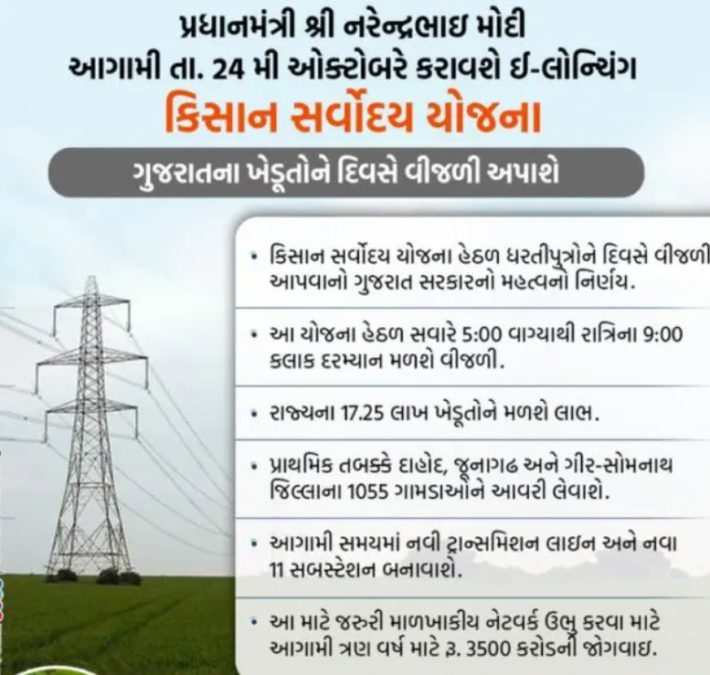
The Gujarat administration is set to roll out the second phase of the Kisan Sarvoday Yojana 2026, aiming to ensure farmers have access to electricity during daylight hours. Previously known as the Dinkar Yojana, the initiative was rebranded as the Kisan Sarvoday Yojana. Prime Minister Narendra Modi inaugurated the first phase via video conference on October 24, 2020, with the second phase expected to begin shortly.
Gujarat Kisan Sarvoday Yojana 2026 [2nd Phase]
The rebranding of the Dinkar Yojana to Kisan Sarvoday Yojana was officially announced in a government notification on October 20, 2020. "Dinkar" translates to "sun" in Gujarati, reflecting the nature of the scheme originally proposed in the state budget.
With an allocated budget of approximately Rs. 3,500 crore, the state government intends to provide daytime electricity for all agricultural operations by the 2023-24 period. To achieve this, the government is initiating
Gujarat Kisan Sarvoday Yojana Phase 1
During the initial phase, 1,055 villages across the Dahod, Junagadh, and Gir Somnath districts received daytime agricultural power. This effort reached roughly 17.25 lakh farmers throughout Gujarat. Under these terms, farmers were provided with two 8-hour windows of electricity between 5 am and 9 pm.
Providing daytime power for farming has been a long-standing request from the agricultural community. Farmers face significant risks working at night, including threats from wild animals and venomous insects, making consistent daytime supply essential.
Execution of Kisan Sarvoday Yojana Phase 1
Reports indicated that there were about 17.25 lakh agricultural power connections categorized into 153 groups across the state. These groups receive 3-phase power for eight hours daily. The distribution is managed through a rotating schedule, alternating between daytime and nighttime slots on a weekly basis to ensure fair access.
READ More: Government Schemes in Gujarat
Primary Obstacles to Daytime Power Access
Outdated power distribution infrastructure is the primary reason many farmers have lacked